Prague 특집호
Walking Charles Bridge Before Prague's Crowds Arrive
The crowds on Prague's most famous bridge run to a timetable, which means you can plan around them: cross in near-silence, pick the right tower to climb, and eat two minutes from either end.

글: Sander BakkerThe city beyond the Charles Bridge crush
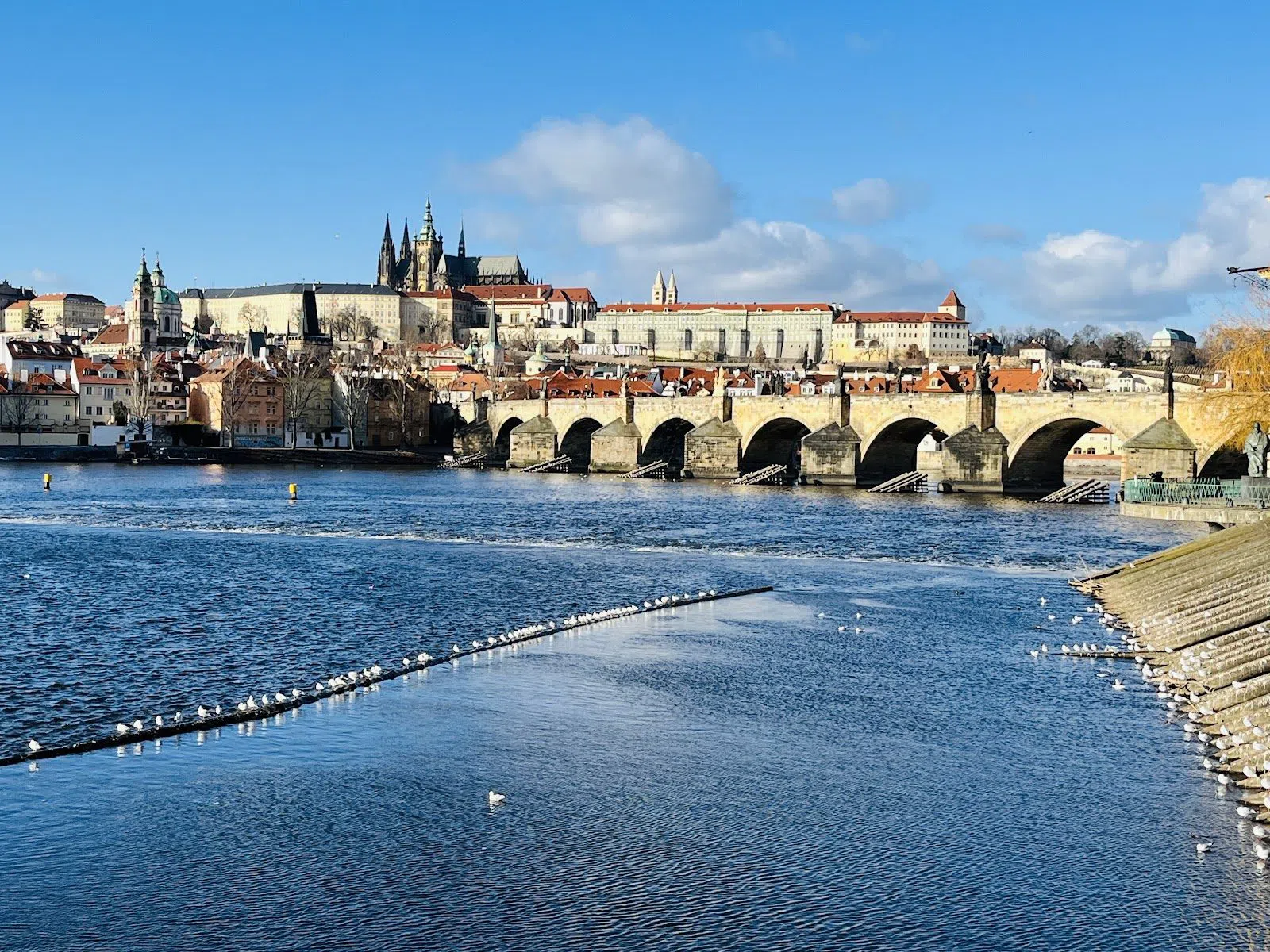
The stone deck of Charles Bridge is about ten metres wide and sixteen arches long, and for most of the daylight hours it carries more people than it was ever shaped to hold. Come at seven in the morning and it is a different structure: gulls on the parapet, the Vltava running fast and brown underneath, a sandstone saint every twenty paces with nobody in front of it. The crowd is a question of timetable, and a timetable can be worked around.
What the crossing actually is
Charles Bridge (Karlův most, joining Staré Město to Malá Strana) is a pedestrian-only sandstone span roughly 515 metres long, begun in 1357 under Charles IV after a flood destroyed the Judith Bridge that had stood on this crossing before it. Sixteen arches, a slight bow in the deck, and thirty statue groups along the parapets, mostly Baroque work from the late seventeenth and early eighteenth centuries. Most of what you pass today are copies; the eroded originals were moved under cover. There is no gate, no ticket, no closing hour and no barrier of any kind. It is a public thoroughfare that happens to be six and a half centuries old.

The walk end to end takes about ten minutes if the deck is clear and twenty-five to thirty if it is not, and nobody sensible crosses it only once. What you actually do is stop: at the crucifix with its gilded Hebrew lettering, at the statue of St John of Nepomuk where generations of hands have polished the relief plaque below it to a shine, at the gap in the parapet where the castle hill arranges itself behind the roofs of Malá Strana. Guided walking groups cross constantly, and the competent guides keep their parties pressed to the parapets where the deck narrows at the statue plinths. If you want to move faster than the crowd, walk the centre line and leave the edges to the photographs.
A rolling, stone-by-stone restoration has been running on the bridge since 2019 and will run for years yet. It takes short sections of parapet out of use at a time behind hoarding, and it has never closed the span. If a few metres of the view you came for are boarded up on the morning you visit, that is the programme at work rather than a problem: walk twenty paces and the frame opens again.
Prague 여행 계획하기
예약 파트너의 실시간 가격입니다.
많은 객실이 무료 취소 가능합니다. 예약 시 당사가 수수료를 받을 수 있습니다.
Three staircases and the view down the deck
The one view you cannot get from the deck is of the deck itself. For that you climb.
Old Town Bridge Tower (Staroměstská mostecká věž, at the Staré Město bridgehead) is the paid add-on worth making, because it is the only vantage point that puts the whole statue-lined span in one frame from above. It costs 250 CZK for an adult, 170 CZK reduced and 500 CZK for a family, with 50 per cent off during the first hour after opening, which is also the hour with the fewest people on the stairs. Take it. The climb is a 138-step spiral and the viewing gallery is tight: a couple or a handful of friends is fine, larger parties get split at the door, and under-15s must be with an adult. Prague City Tourism runs it, and it stays open to visitors through the long-running renovation of the tower's upper shell. It is not barrier-free.
Lesser Town Bridge Towers (Malostranské mostecké věže, the Malá Strana bridgehead) are the quieter climb of the two, and the one that gives you the bridge with the castle hill stacked up behind it. Tickets sit between 150 and 250 CZK for an adult and are sold only at the box office inside the tower. There is no advance online booking, which is exactly why it stays calmer. The stairs take individuals and small groups, and there is no coach-group handling at all. Use it as your fallback whenever there is a line at the Old Town tower door; the view is different, not lesser.
St Nicholas Bell Tower (Svatomikulášská městská zvonice, five minutes uphill into Malá Strana) is for the shot that includes the bridge instead of standing on it. It is 200 CZK adult, 130 CZK reduced, and 215 steps. The staircase limits you to small groups, so larger parties go up in waves. The tower has a second draw beyond the view: the room used as a surveillance post during the Communist decades, watching the embassies below.
The frontal photograph and the engineering behind it
Bedřich Smetana Museum (Novotného lávka, Staré Město) holds the cheapest ticket on this list: 70 CZK adult, 50 CZK reduced, under-15s free with an adult, open 10:00 to 17:00 and closed on Tuesdays, with school and youth groups at 30 CZK a head. It is worth knowing about even if you have no interest in the composer, because the terrace it sits on is where the classic head-on photograph of the bridge is taken. The building is small and the exhibition is upstairs, so groups rotate through rather than flow, and it is not wheelchair accessible.
Charles Bridge Museum and Prague Venice boat trips (Muzeum Karlova mostu / Pražská Benátka, on the Staré Město bank) is one operator doing two jobs, so count it as one venue. The museum is the only place that treats the bridge as a piece of engineering: how the foundations were set, how the arches were turned, how it has survived floods that took its predecessor. The same company runs the little launches that go under the arches and into the mill channel. The museum alone is 220 CZK adult and 110 CZK reduced; museum plus the cruise is 550 CZK and 350 CZK, and a four-site combination ticket is 650 CZK. The combined version is the sensible one. The boats seat roughly 30 to 35 people, so a larger party is split across consecutive departures and should contact the sales department rather than turning up and hoping.
Down the stairs to Kampa
Kampa Island (Na Kampě and Kampa Park, Malá Strana) is reached by the stairs off the bridge deck itself, and those stairs are the most useful thing on the crossing. Thirty seconds after leaving the crush you are underneath it, at water level, looking up at the arches with the mill wheel turning nearby. The park is free, unrestricted and open, and it is the standard place guides park a group to talk without blocking the bridge. A long-planned renewal of the park was finally contracted in September 2026, staged so the park stays open with minimal restrictions, so expect some fenced patches rather than a closure.
Museum Kampa (Kampa Island) is the one indoor attraction on the island: the Mládek collection, strong on Kupka and Gutfreund and on twentieth-century Eastern-bloc work that most visitors have never been shown. A mid-range museum ticket, open daily 10:00 to 18:00 with last entry half an hour before close. It takes groups and will arrange a guided visit on request, and the riverside sculpture lawn absorbs larger parties comfortably. David Černý's crawling bronze babies outside cost nothing to look at and are the most photographed thing on the island after the bridge.
Mlýnská kavárna (Kampa) is two minutes from the bridge and priced like the Prague the bridge is not: local money for coffee, beer and wine. It is small and locals-first, so bring a few people at most and do not arrive with a tour. It is still actively run in 2026 and co-organises the Kampa střed světa street party each April. The mill wheel beside the terrace is the detail people remember.
Five minutes off the deck
Vojan Gardens (Vojanovy sady, Malá Strana) is the nearest real escape from the bridge crush: a walled garden two minutes from the Lesser Town tower, free, open from 8:00 until somewhere between 16:00 and 19:00 depending on the month. Groups are allowed and guides keep voices down, because quiet is the whole point of the place. Almost nobody standing on the bridge knows the gate is there.
Lennon Wall (Velkopřevorské náměstí, Malá Strana) is five minutes from the bridge's Malá Strana end and the natural second stop: a wall that has been painted, overpainted and argued about since the 1980s. Free, ungated, reachable at any hour. It sits in a narrow dead-end lane, so a large party simply plugs it, and early morning is the only time a group fits in there comfortably. Since the Knights of Malta took a firmer hand on its upkeep, unsanctioned spraying is discouraged, so bring a camera rather than a can.
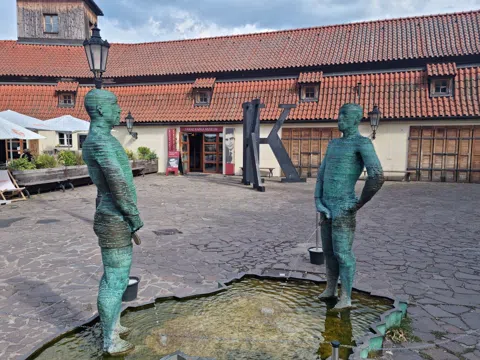
Franz Kafka Museum (at the Malá Strana bridgehead) is 300 CZK adult, 220 CZK reduced and 800 CZK family, open daily 10:00 to 18:00. Private guided tours run in five languages if you email at least seven days ahead, at roughly 1,000 CZK plus entry. This is the stop for readers who want ideas rather than views. The staging is deliberately atmospheric and claustrophobic, which some visitors find brilliant and others find airless. Know which you are before you pay.
Klementinum Baroque Library and Astronomical Tower (Staré Město, two minutes from the Old Town bridgehead) is the best answer to rain or to the flat heat of a July afternoon. Entry is by timed guided slot only, in fixed group sizes, for a 45-minute tour at roughly 230 to 350 CZK per person and 810 CZK for a family, with 50 per cent off the first two morning tours, 09:00 in English and 09:30 in Czech. A large party must either book a slot or be split across two. The library hall itself is viewed from the doorway, not walked through; the astronomical tower and the meridian hall are the parts you move around in.
Eating within two minutes of either end
BRICK'S — Hergetova Cihelna (Malá Strana riverside) has the front-row table for the bridge and is the right place to put a group of adults at sunset. The heated terrace section seats about 60 year-round and the full terrace takes up to 180 seated or 250 standing in warm months, which makes it one of very few explicit group-dining operations this close to the water. Mains are upper-mid to expensive, the menu is international with steaks and seafood and a long wine list. The name changed in 2022: this is the former Hergetova Cihelna, rebranded BRICK'S, so older guidebooks still send people hunting for a restaurant that no longer uses that name on its own.
Lokál U Bílé kuželky (Malá Strana) is the honest answer to the question of where to eat near Charles Bridge without being fleeced: unfiltered tank Pilsner Urquell, proper Czech cooking, local prices, no laminated tourist menu propped outside. It is one of the largest Lokál rooms and genuinely group-capable with a reservation. Open 11:00 to midnight Monday to Saturday and 11:00 to 23:00 on Sunday, with kitchen orders taken until 21:45, which catches people who think they can eat at half past ten.
Tickets at the door and whether to book anything
The bridge itself cannot be booked, queued for or sold to you. Everything around it can. The Old Town tower is a walk-up in practice, and the first hour after opening gets you in at half price with the fewest people on the spiral. The Lesser Town towers are box office only, so arrive with the cash or card in hand and no expectation of skipping anything. The Klementinum needs a slot. The boat under the arches needs a phone call if you are more than a dozen people.
Guided options do exist and run seven days a week, from around 45 USD per person, and demand for them is steady year-round: the bookable tours at this attraction carry 17,469 traveller reviews between them, and the top-rated one holds 4.9 out of 5 from 4,589 reviews. That tells you the guiding here is good, not that you need it. A guide earns the money on history and on linking the bridge to the city either side of it. No guide can make the deck emptier. The quiet hour is free, and it does more for the visit than any ticket.
Access, surfaces and simple rules
The deck is level and pedestrian-only, so a pram or a wheelchair can cross it, but the surface is old, cobbled and uneven, and the approach from Kampa is a flight of stairs with no lift. The towers are all stair-only: the Old Town tower is explicitly not barrier-free, and the Smetana museum building is not wheelchair accessible either. Because the bridge is a pedestrian deck, cycle tours dismount and push across it rather than riding.
In the dense middle hours the bridge is a slow-moving press of people with bags open and phones out, so carry yours in front of you and do not stop dead in the stream to frame a shot. Step into a statue alcove instead. And if you are the one with a group, use Kampa Island or the open square at the Lennon Wall to talk, not the deck. The locals crossing to work will thank you.
Is it worth it
Yes, with one condition attached. Charles Bridge is free, unavoidable and one of the great pieces of medieval infrastructure still doing its original job, and at the wrong hour it is a corridor of selfie sticks that teaches you nothing. The value is entirely in when you show up. Given an early hour it suits everybody: couples, solo walkers, photographers, anyone who likes old engineering, families with children who will be more interested in the boats underneath than the saints above.
Who should manage expectations: anyone with limited mobility, who will find the deck fine and the towers closed to them; anyone who hates crowds and can only visit between ten and six, who should cross once for the sake of it and spend the rest of the time in the Vojan Gardens, at Museum Kampa or in the Klementinum; and anyone hoping for a serene photograph at sunset, which is the busiest beautiful hour of the day.
Best time to go
First light to about 08:00 is the window, and it is not close. The deck is near-empty, the light comes down the river from the east, and the statues read as sculpture rather than obstacles. Between roughly 09:00 and 18:00 the bridge is continuously busy, peaking in the late afternoon and at sunset. A second, softer quiet window opens after about 21:00, when the statues are lit, the day groups have gone to dinner and the bridge belongs to couples and the occasional busker.
Midweek beats the weekend by a visible margin. Winter mornings are the best of all: cold, often foggy off the water, with the castle appearing and disappearing above Malá Strana, and the towers and museums all still open. Rain thins the deck faster than anything else, which is the moment to be glad you know about the Klementinum, the Kafka museum and the bridge museum. If you are climbing a tower, line your visit up with its opening hour and take the half-price first hour at the Old Town tower or the first morning tours at the Klementinum.
Practical notes
Getting there is easy. Metro line A serves both ends: Staroměstská for the Old Town side, Malostranská for Malá Strana, each about five minutes on foot. The riverside trams 17 and 18 stop at Staroměstská; trams 12, 15, 20 and 22 run to Malostranské náměstí for the far bridgehead. Walking to the bridge from either old centre takes under ten minutes, and at six in the morning the trams are already running.
Prices are in Czech crowns (CZK) and cards work nearly everywhere, including most museum desks, but keep a few hundred crowns in cash for the small tower box offices and the cheaper cafés. Ignore street exchange booths near the bridgeheads; use a bank or an ATM you recognise.
On timing, give the crossing itself 30 minutes with stops, one tower another 45, and a Kampa detour half an hour. Bridge, one tower, the stairs down to Kampa and lunch is a comfortable half day.
On money, the bridge is free, as are Kampa Island, the Vojan Gardens and the Lennon Wall. One tower is 250 CZK, or 125 CZK in the first hour; the bridge museum with the boat is 550 CZK; the Smetana museum is 70 CZK; a tank-beer lunch at Lokál is cheap by any Western European standard. A full day of bridge, two climbs, one museum and a proper lunch lands under about 1,500 CZK per person, and you can do a very good version of it for a quarter of that.
Where you sleep decides the rest. The only reliable way to be on the deck at six in the morning is to stay within ten minutes of it: Malá Strana for quiet, Staré Město for everything else. See the Prague hotel search for what is actually available on your dates. For the rest of the city beyond the river, start with the Prague guide.
떠나기 전에
What time should I cross Charles Bridge to avoid the crowds?
From first light to about 08:00 the deck is near-empty and the light comes up the river from the east. That is the one reliably quiet window. A softer lull opens again after roughly 21:00, once the statues are lit and the day groups have gone to dinner. Between 09:00 and 18:00 the bridge is busy without a break, and sunset is the busiest attractive hour of all. Midweek is noticeably calmer than the weekend, and winter mornings are quietest.
Do I need a ticket for Charles Bridge?
No. The bridge is a free public thoroughfare: there is no ticket and no barrier, and it never closes, so you can walk it at any hour. The towers and the museum are what cost money. The Old Town Bridge Tower is 250 CZK adult (170 CZK reduced, 500 CZK family, half price in the first hour after opening), the Lesser Town Bridge Towers fall in the 150 to 250 CZK band, and the Charles Bridge Museum is 220 CZK, or 550 CZK with the boat ride under the arches.
Which bridge tower is better to climb?
The Old Town Bridge Tower is the only place that frames the whole statue-lined deck from above, so it is the one to pick if you climb just one. It is 138 steps up to a tight gallery, and larger parties get split at the door. The Lesser Town Bridge Towers are quieter, sell tickets only at the box office inside with no advance online booking, and give you the bridge with the castle hill behind it. Use them whenever there is a line at the Old Town door.
Is a guided tour of Charles Bridge worth paying for?
A guide earns its fee on the history, and on tying the bridge to the two districts it joins. It buys you nothing in access, since there is no queue to skip in the first place. Guided options run seven days a week from around 45 USD per person, and the guiding here is well reviewed: 17,469 traveller reviews across the bookable tours at this attraction, with the top-rated one at 4.9 out of 5 from 4,589 reviews. If you want an empty deck rather than commentary, an early alarm costs nothing and works better.
Is Charles Bridge accessible with a wheelchair or a pram?
The deck itself is flat and pedestrian-only, so crossing it is manageable, though the surface is old and cobbled and the shortcut down to Kampa Island is a staircase with no lift. All the towers are stair-only, and the Old Town Bridge Tower is explicitly not barrier-free. The Bedřich Smetana Museum building is not wheelchair accessible either. For step-free ground nearby, there is Kampa Island, the Vojan Gardens and the riverside sculpture lawn at Museum Kampa.